

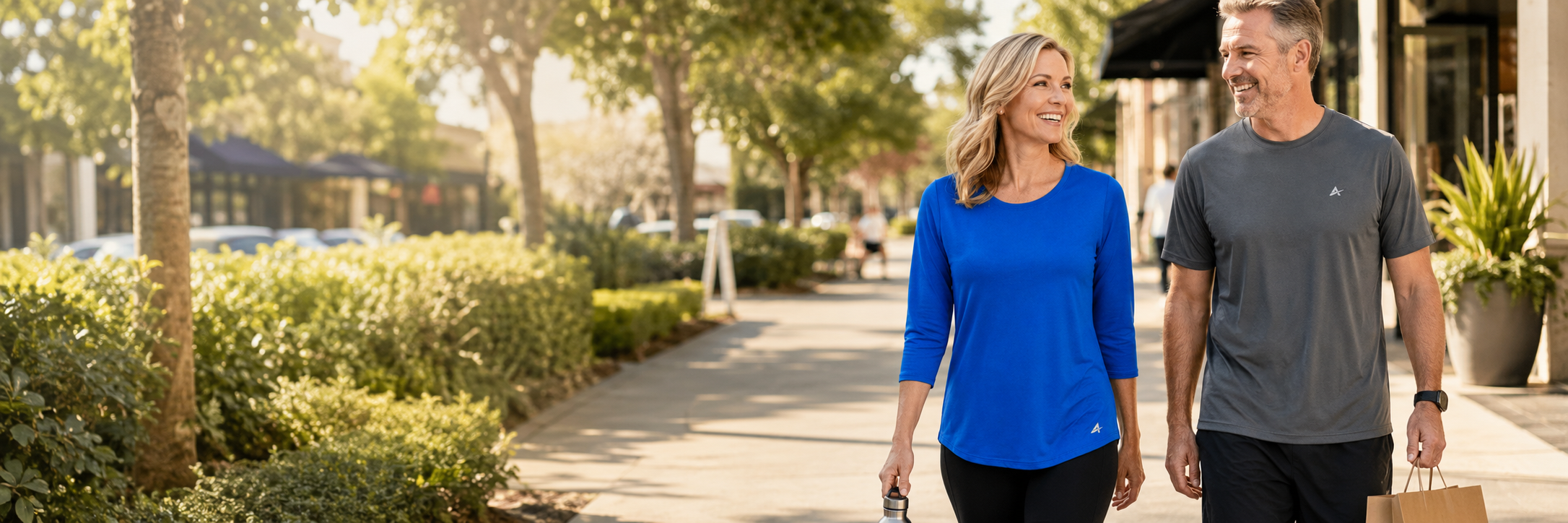
Best Shirts for People Who Hate Feeling Sweaty
Some people do not mind sweating. What they hate is everything that happens to their clothing afterward.
The shirt begins sticking to the back. The fabric feels damp around the chest or underarms. The hem clings after sitting in a warm car. Sleeves start feeling heavier, and the same shirt that felt comfortable in the morning becomes distracting by the afternoon.
No shirt can promise that you will never perspire or that fabric will remain completely dry in every condition. However, the right combination of breathability, moisture management, quick drying, stretch, and fit can make the experience feel much more manageable.
This guide compares four Arctic Cool shirts for people who particularly dislike that damp, sticky feeling:
- Men’s Cooling Crew Neck T-Shirt
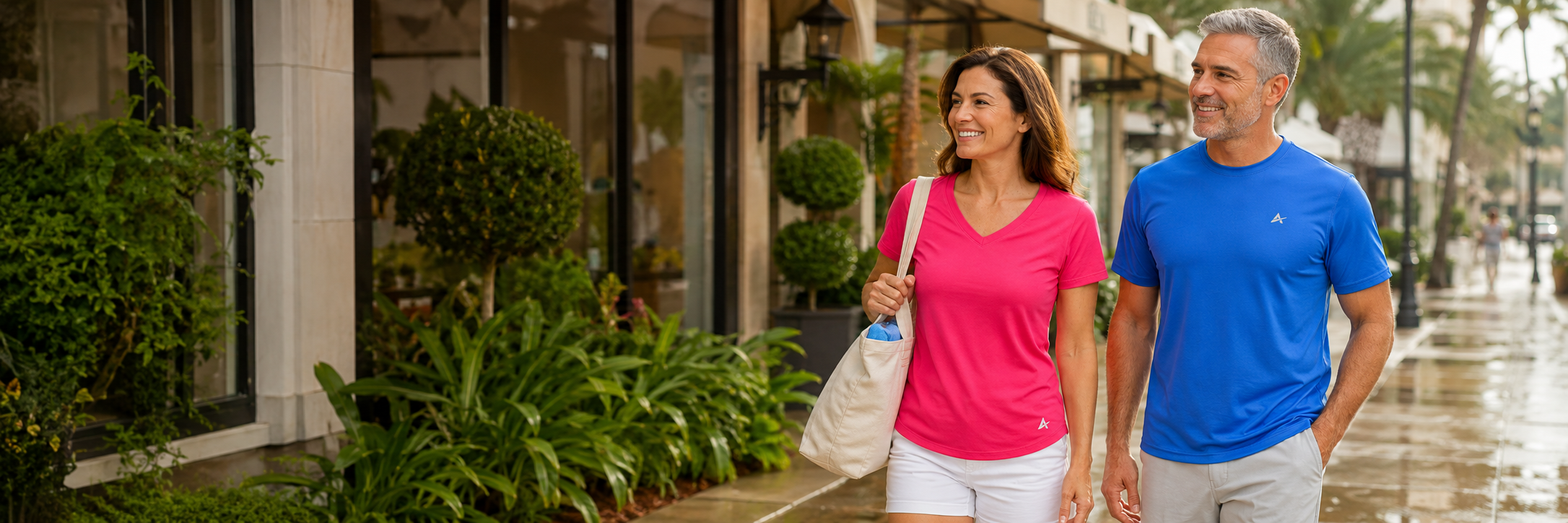
- Women’s Cooling V-Neck Short Sleeve T-Shirt
- Women’s Cooling 3/4 Sleeve T-Shirt
- Men’s Cooling Pocket Workwear T-Shirt
Each shirt is designed around temperature regulation and moisture management, but each has a different silhouette. The best choice depends on where fabric tends to bother you, how much room you prefer, the coverage you want, and what you will be doing while wearing it.
This article is part of the Arctic Cool Staying Cool Hub, our central resource for clothing, fabric technology, heat, humidity, sweat, travel, outdoor activity, and everyday warm-weather comfort.
Quick answer: The best shirts for people who hate feeling sweaty combine breathable, moisture-wicking, quick-dry fabric with a fit that supports airflow and movement. Choose an active-fit Crew or V-Neck for everyday wear, a relaxed Women’s 3/4 Sleeve for free-flowing coverage, or a longer, boxier Pocket Workwear Tee for work and outdoor projects.
Why Sweaty Clothing Feels So Uncomfortable
The discomfort is not caused by perspiration alone. It develops through the way moisture, fabric, weather, fit, and movement interact.
A shirt may start feeling uncomfortable when:
- Perspiration collects between the skin and fabric
- The material absorbs moisture and holds it
- Humidity slows evaporation
- The shirt fits closely around the back, chest, waist, or arms
- Dense fabric limits airflow
- The garment dries slowly after activity
- Damp fabric bunches or rubs during movement
The same amount of perspiration can feel very different depending on the shirt you are wearing.
For the broader explanation of why heat, activity, humidity, and sun can increase perspiration, read Why Do I Sweat So Much in the Heat?.
What to Look for When You Hate Feeling Sweaty
The best solution is not simply choosing the thinnest or loosest shirt available. A thin shirt may still cling, and an oversized shirt may create extra damp material that bunches around the body.
Look for a complete fabric-and-fit system.
Breathable Construction
Breathability helps air move through and around the material.
This can make the shirt feel less enclosed during warm commutes, sunny parking lots, walking, outdoor work, travel, yard projects, golf, or humid afternoons.
Moisture-Wicking Performance
Moisture-wicking fabric helps move perspiration away from the skin and distribute it through the garment.
This does not prevent sweating. It helps keep moisture from remaining concentrated in one small area of the shirt.
Quick-Dry Fabric
A shirt may become damp during one part of the day and still need to remain wearable for several more hours.
Quick-dry performance helps the garment recover after a warm commute, outdoor walk, yard project, travel transfer, or active work period.
Lightweight Stretch
Stretch helps the shirt move with the shoulders, arms, back, chest, and waist rather than pulling tightly during activity.
This is especially useful while walking, reaching, bending, driving, carrying bags, gardening, working, or traveling.
The Right Fit
A very tight shirt may remain pressed against the body once it becomes damp. An extremely loose shirt may fold, bunch, or feel heavier after absorbing moisture.
Choose a fit that provides enough room for comfortable movement without adding unnecessary excess fabric.
Fabric That Performs After It Becomes Damp
Do not judge a hot-weather shirt only by how light it feels while clean and dry.
Consider how it behaves after heat, moisture, humidity, and movement become part of the day.
Our guide to Cooling Fabrics Explained provides a deeper look at breathability, moisture movement, airflow, evaporation, and temperature regulation.
Cooling, Moisture-Wicking, and Quick-Dry Are Not Identical
These terms are related, but they describe different parts of the fabric system.
Moisture-Wicking
Moisture-wicking fabric helps pull and spread perspiration through the material instead of allowing it to remain concentrated against one area of the body.
Quick-Dry
Quick-dry performance describes how efficiently the material releases moisture and recovers after becoming damp.
Temperature Regulation
Temperature-regulating fabric may combine moisture movement, airflow, evaporation, and specialized technology to support a cooler-feeling wearing experience as heat and activity increase.
A strong hot-weather shirt should ideally bring these functions together rather than relying on one feature by itself.
Read Cooling vs. Moisture-Wicking for a complete comparison.
How HydroFreeze X™ Fits the Sweat-Comfort Story
Arctic Cool apparel is built around HydroFreeze X™, a sweat-activated temperature-regulating technology designed to work as moisture, movement, and airflow interact with the fabric.
ActiveWick moisture-wicking technology helps disperse perspiration through the garment. Breathable construction supports airflow, while quick-dry performance helps the material recover after becoming damp.
The technology does not stop perspiration or guarantee that a shirt will remain completely dry. It is designed to help put moisture and airflow to work rather than allowing heavy, slow-drying fabric to remain against the body.
Learn more through the Arctic Cool Technology Page and How Sweat-Activated Cooling Works.
Best Everyday Men’s Shirt: Cooling Crew Neck
The Men’s Cooling Crew Neck T-Shirt is the most versatile men’s option in this comparison.
It uses an active fit with a slight taper while remaining loose enough for comfortable movement. That gives it the familiar appearance of an everyday tee without making it a compression-style shirt.
The Men’s Crew works well for:
- Daily errands
- Walking
- Travel and road trips
- Warm commutes
- Backyard activities
- Casual outdoor plans
- Light yard work
- Everyday summer wear
Why Choose the Men’s Crew?
- It has a familiar everyday T-shirt silhouette.
- The active fit provides shape without fitting like compression apparel.
- Four-way stretch supports comfortable everyday movement.
- Moisture-wicking performance helps disperse perspiration.
- Quick drying helps the shirt recover after a warm part of the day.
Choose the Men’s Crew when you want a dependable shirt for everyday movement and do not need the extra length or boxier shape of a traditional workwear tee.
Best Everyday Women’s Shirt: Cooling V-Neck
The Women’s Cooling V-Neck Short Sleeve T-Shirt provides an active everyday fit with a more open neckline.
The slight taper creates shape through the chest, waist, and hips while leaving enough room for comfortable active movement.
The Women’s V-Neck works well for:
- Errands and appointments
- Walking
- Travel
- Casual workdays
- Outdoor meals
- Warm indoor spaces
- Weekend routines
- Indoor-to-outdoor temperature changes
Why Choose the Women’s V-Neck?
- The open neckline creates a lighter everyday silhouette.
- Short sleeves provide less arm coverage than the 3/4 Sleeve.
- The active fit follows the body without being a compression shirt.
- Four-way stretch supports walking, reaching, driving, and sitting.
- Moisture-wicking and quick-dry performance help manage perspiration through a changing day.
Choose the V-Neck when you prefer a shaped everyday fit, short sleeves, and a top that can move naturally between errands, travel, walking, and casual plans.
Best Relaxed Women’s Shirt: Cooling 3/4 Sleeve
The Women’s Cooling 3/4 Sleeve T-Shirt offers the most relaxed women’s fit in this comparison.
Its free-flowing silhouette provides more room through the body and can be especially useful for women who dislike shirts fitting closely around the waist, upper arms, or torso.
The Women’s 3/4 Sleeve works well for:
- Gardening
- Outdoor errands
- Walking
- Travel
- Farmers markets
- Patio plans
- Cold air conditioning followed by outdoor heat
- Days when additional arm coverage is preferred
Why Choose the Women’s 3/4 Sleeve?
- The relaxed fit provides more room through the body.
- The free-flowing silhouette supports comfortable movement.
- The 3/4 sleeves provide coverage without requiring a heavy layer.
- The scoop neckline keeps the upper silhouette open.
- Moisture-wicking and quick-dry performance support comfort despite the additional sleeve coverage.
Choose the 3/4 Sleeve when you prefer a relaxed rather than shaped fit, want additional coverage, or regularly move between outdoor heat and cold indoor air conditioning.
Best Roomy Men’s Shirt: Pocket Workwear Tee
The Men’s Cooling Pocket Workwear T-Shirt has a longer, boxier silhouette than the standard Men’s Crew.
It is designed for customers who prefer a traditional workwear or tall fit with more room through the torso.
The Pocket Workwear Tee works well for:
- Garage projects
- Yard work
- Property maintenance
- Outdoor jobs
- Workshop tasks
- Grilling and backyard projects
- Repeated bending and reaching
- Customers who prefer additional shirt length
Why Choose the Pocket Workwear Tee?
- The longer, boxier cut provides more room through the torso.
- The traditional workwear silhouette is less tapered than the Men’s Crew.
- The added body length can provide useful coverage while bending or reaching.
- Four-way stretch supports lifting, carrying, and repeated movement.
- The chest pocket adds practical everyday utility.
Choose the Pocket Workwear Tee when you prefer a roomier silhouette, need additional body length, or want a shirt designed around outdoor work and practical projects.
Explore more options in the Best Work Shirts for Hot Weather guide.
Men’s Cooling Crew vs. Pocket Workwear Tee
Choose the Men’s Crew for:
- An active everyday fit
- Walking and errands
- Travel and road trips
- Casual outdoor activities
- A slightly tapered silhouette
- Easy everyday styling
Choose the Pocket Workwear Tee for:
- A longer, boxier fit
- Outdoor work
- Garage or property projects
- A traditional workwear silhouette
- A practical chest pocket
- More room through the torso
Both shirts use breathable, moisture-wicking, quick-dry fabric. The main decision is whether you prefer an active everyday silhouette or a longer, roomier workwear fit.
Women’s V-Neck vs. 3/4 Sleeve
Choose the Women’s V-Neck for:
- An active, slightly shaped fit
- Short sleeves
- An open V-neckline
- Errands, walking, travel, and casual workdays
- Warmer days when less sleeve coverage feels better
Choose the Women’s 3/4 Sleeve for:
- A relaxed, free-flowing fit
- Additional arm coverage
- A scoop neckline
- Gardening, travel, errands, and changing temperatures
- A less fitted waist and torso
The choice involves more than sleeve length. It also depends on whether you prefer an active silhouette or a more relaxed one.
Which Shirt Fits Your Main Clothing Complaint?
If Fabric Bothers You Around the Chest or Waist
A less tapered silhouette may feel more comfortable.
Women may prefer the relaxed Women’s 3/4 Sleeve. Men who want additional room may prefer the Pocket Workwear Tee rather than the active-fit Crew.
If Sleeves Feel Restrictive
Consider both sleeve length and fit.
The Women’s V-Neck provides shorter sleeves, while the Women’s 3/4 Sleeve provides more coverage in a relaxed silhouette. Men who need additional movement for outdoor work may prefer the roomier Pocket Workwear Tee.
If the Shirt Pulls While Reaching
Look for four-way stretch and enough room across the shoulders and back.
This is particularly important during outdoor work, gardening, luggage handling, yard projects, or any activity involving repeated overhead or forward movement.
If the Hem Sticks After Sitting
Consider the shirt’s body length and waist shape.
The longer Pocket Workwear Tee may be useful for men who want additional coverage while sitting or bending. Women who prefer a freer hem may feel more comfortable in the relaxed 3/4 Sleeve.
If Your Back Feels Damp After Walking
Prioritize moisture movement, breathability, and quick drying.
No shirt prevents perspiration, but a performance fabric can disperse moisture and recover more efficiently than a heavy, absorbent material.
Best Shirts for Humid Weather
Humidity can make clothing remain damp for longer because evaporation becomes less efficient when the air already contains significant moisture.
For humid conditions, prioritize:
- Moisture-wicking fabric
- Quick-dry performance
- Breathability
- Four-way stretch
- A fit that is not excessively tight
- A silhouette appropriate for the activity
Choose the Crew or V-Neck for everyday movement, the Women’s 3/4 Sleeve for relaxed coverage, or the Pocket Workwear Tee when work requires a roomier silhouette.
Learn more in The Best Fabric for Hot and Humid Weather.
Best Shirts for Errands and Travel
Errands and travel can involve warm cars, sunny parking areas, luggage, walking, cold air conditioning, and hours without an easy opportunity to change.
The Men’s Crew and Women’s V-Neck are the simplest everyday options because their silhouettes work naturally for walking, stores, restaurants, driving, and casual plans.
The Women’s 3/4 Sleeve is useful when colder indoor spaces make additional coverage desirable.
Choose a shirt that:
- Moves comfortably while sitting and walking
- Dries efficiently after warm outdoor transitions
- Does not require an immediate change after becoming damp
- Still looks appropriate for the rest of the schedule
Best Shirts for Yard Work and Outdoor Projects
Outdoor projects add bending, lifting, reaching, carrying, and repeated movement to the heat.
For lighter projects, the Men’s Crew, Women’s V-Neck, or Women’s 3/4 Sleeve may be appropriate.
For men who want a traditional workwear shape with more body room and length, the Pocket Workwear Tee is the strongest option in this comparison.
Pair the shirt with movement-friendly bottoms and plan water, shade, and appropriate breaks during extended outdoor work.
How to Check the Fit Before Choosing
Fit should be evaluated while moving, not only while standing in front of a mirror.
Consider how the shirt feels when you:
- Raise both arms
- Reach forward
- Sit in a car or chair
- Bend at the waist
- Carry a bag or tool
- Walk for several minutes
- Turn through the shoulders
The shirt should have enough room to move without creating excessive fabric that bunches or folds.
Review the size guide on the individual product page because the four featured shirts do not use the same silhouette.
How to Care for Moisture-Managing Shirts
Proper care helps preserve the fabric’s airflow and moisture-management performance.
Follow the instructions on the garment label and individual product page. Current Arctic Cool care guidance for the featured shirts includes:
- Machine washing in cold water
- Tumble drying on low
- Using only non-chlorine bleach when needed
- Not ironing the fabric
- Avoiding fabric softeners and fabric-softener sheets
Fabric softener can leave residue that affects airflow and fabric performance.
What to Avoid When You Hate Feeling Sweaty
- Heavy fabric that absorbs and retains moisture
- Shirts that remain damp for hours
- Extremely tight fits during active hot-weather plans
- Dense materials with limited airflow
- Stiff fabric that pulls during movement
- Excess fabric that bunches around the waist or back
- Choosing a fit without considering how you sit, bend, or reach
- Using fabric softener on performance apparel
- Expecting clothing to prevent the body from sweating
How This Guide Differs From Our Broader Sweat Guide
Best Shirts for People Who Sweat a Lot is the broader guide to sweat-friendly fabrics and clothing features.
This guide focuses more specifically on:
- The discomfort of damp fabric against the skin
- How shirt fit affects that discomfort
- Active fits compared with relaxed fits
- Short sleeves compared with 3/4 sleeves
- Everyday silhouettes compared with workwear silhouettes
- Choosing among four specific Arctic Cool products
Use the broader guide to understand the fabric requirements, then use this comparison to select the fit that best matches your activity and preferred coverage.
Shop Shirts for Sweat and Hot-Weather Comfort
- Choose the Men’s Cooling Crew Neck T-Shirt for an active everyday fit.
- Choose the Women’s Cooling V-Neck Short Sleeve T-Shirt for a shaped everyday fit and open neckline.
- Choose the Women’s Cooling 3/4 Sleeve T-Shirt for relaxed coverage and a free-flowing silhouette.
- Choose the Men’s Cooling Pocket Workwear T-Shirt for a longer, boxier workwear fit.
- Explore the Men’s Cooling Collection, Women’s Cooling Collection, and Men’s Workwear Shop for more options.
Choose the Fabric and the Fit
When you hate feeling sweaty, the problem is rarely one detail.
Moisture may be drying slowly. The fabric may be holding perspiration. The fit may keep damp material close to the body. The shirt may not have enough stretch for the activity, or it may contain more loose material than you need.
Begin with breathable, moisture-wicking, quick-dry fabric. Then choose the silhouette that fits your day.
Select the Men’s Crew for a versatile active fit. Choose the Women’s V-Neck for a shaped everyday option. Pick the Women’s 3/4 Sleeve for relaxed coverage. Use the Pocket Workwear Tee when a longer, boxier workwear fit makes more sense.
No shirt can promise a completely moisture-free day. The right product can help keep the fabric lighter, more flexible, and less distracting when heat and perspiration become part of your schedule.
Frequently Asked Questions
What kind of shirt is best for people who hate feeling sweaty?
Look for a lightweight shirt with breathable, moisture-wicking, quick-dry fabric and enough room for comfortable movement. Four-way stretch and a fit suited to your activity can also help reduce pulling, bunching, and distracting damp fabric.
Does moisture-wicking fabric stop a shirt from feeling damp?
Moisture-wicking fabric cannot guarantee that a shirt will remain completely dry. It helps move and spread perspiration through the material so moisture can dry more efficiently and feel less concentrated against the skin.
Is a loose shirt always better if I sweat a lot?
Not always. A very tight shirt may cling quickly, while an extremely loose shirt may bunch or feel heavier after absorbing moisture. Choose a fit that provides comfortable airflow and movement without unnecessary excess fabric.
Which Arctic Cool shirt has the roomiest fit?
The Men’s Pocket Workwear Tee has a longer, boxier relaxed fit for customers who prefer a traditional workwear or tall silhouette. The Women’s 3/4 Sleeve also has a relaxed, free-flowing fit for women who want additional coverage.
Can a cooling shirt prevent sweating?
No. Cooling apparel does not prevent the body from sweating. It is designed to support comfort through temperature regulation, breathability, moisture management, quick drying, and lightweight stretch.

Leave a comment
This site is protected by hCaptcha and the hCaptcha Privacy Policy and Terms of Service apply.